| In Flanders Fields |
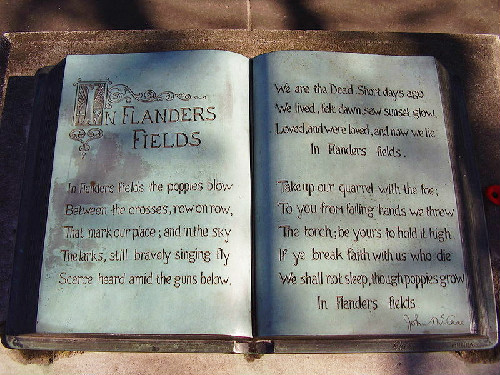
| In Flanders fields the poppies blow, Between the crosses, row on row, That mark our place; and in the sky The larks, still bravely singing, fly Scarce heard amid the guns below. We are the Dead. Short days ago We lived, felt dawn, saw sunset glow, Loved and were loved, and now we lie, In Flanders fields. Take up our quarrel with the foe: To you from failing hands we throw The torch, be yours to hold it high. If ye break faith with us who die, We shall not sleep, though poppies grow In Flanders fields. -- Lt. Col. John McCrae |
Lt. Col. John McCrae was a surgeon, author, poet and soldier who was attached to the
Canadian First Field Artillery Brigade in World War I. In 1915, he participated in the Second
Battle of Ypres (Belgium), which was the first time Germany used poison gas on a large scale
on the Western Front. After the terrible seventeen-day battle, in which John McCrae had
seen more than 6,000 Canadian casualties, he sat in the back of an ambulance and took 15
minutes of his very limited rest time to write a poem that was to become famous all over the
world. He titled it "In Flanders Fields." Lt. Col. McCrae didn't think much of his effort and
later crumpled it up and tossed it away. Another officer rescued it and sent it to newspapers
in London, where it was published. It was an immediate success and became widely known in
a very short period of time.
Lt. Col. McCrae continued his duties in the war until 1918, when, while commanding the No.
3 Canadian General Hospital at Boulogne, France, he died of pneumonia and meningitis. He
is buried at the nearby Wimereaux Cemetery.
The Flanders region of Belgium saw four years of deadly trench warfare and, by the end of
the war, there were hundreds of cemeteries, holding the remains of hundreds of thousands
of soldiers, of many nationalities. In the village of Saint Julien, Belgium, there is a monument
to the valor of the Canadian forces who participated in the Second Battle of Ypres.
Thanks to Lt. Col. McCrae's poem, the red poppies of the fields of Flanders, Belgium - which
sprouted from soil upturned by the digging of fresh graves in makeshift cemeteries - have
come to be recognized as a symbol of the sacrifices of soldiers.
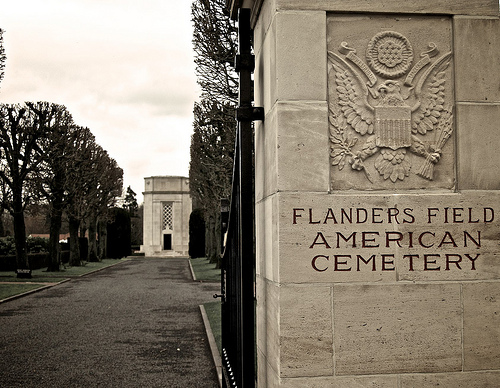
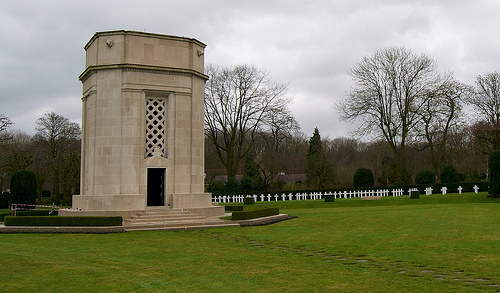
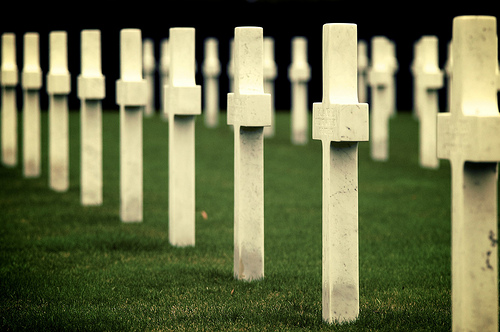
The photo above and four below are of Flanders Field Cemetery in Belgium.
Canadian First Field Artillery Brigade in World War I. In 1915, he participated in the Second
Battle of Ypres (Belgium), which was the first time Germany used poison gas on a large scale
on the Western Front. After the terrible seventeen-day battle, in which John McCrae had
seen more than 6,000 Canadian casualties, he sat in the back of an ambulance and took 15
minutes of his very limited rest time to write a poem that was to become famous all over the
world. He titled it "In Flanders Fields." Lt. Col. McCrae didn't think much of his effort and
later crumpled it up and tossed it away. Another officer rescued it and sent it to newspapers
in London, where it was published. It was an immediate success and became widely known in
a very short period of time.
Lt. Col. McCrae continued his duties in the war until 1918, when, while commanding the No.
3 Canadian General Hospital at Boulogne, France, he died of pneumonia and meningitis. He
is buried at the nearby Wimereaux Cemetery.
The Flanders region of Belgium saw four years of deadly trench warfare and, by the end of
the war, there were hundreds of cemeteries, holding the remains of hundreds of thousands
of soldiers, of many nationalities. In the village of Saint Julien, Belgium, there is a monument
to the valor of the Canadian forces who participated in the Second Battle of Ypres.
Thanks to Lt. Col. McCrae's poem, the red poppies of the fields of Flanders, Belgium - which
sprouted from soil upturned by the digging of fresh graves in makeshift cemeteries - have
come to be recognized as a symbol of the sacrifices of soldiers.
The photo above and four below are of Flanders Field Cemetery in Belgium.

| The link to this page is: http://old-new-orleans.com/Flanders.html The photos on this page are courtesy of janheuninck. Oradour-sur-Glane: The Silent Village Old New Orleans Whispers |